

Cash, Conventional, FHA, VA or Rural Development: What Sellers Should Know Before Choosing an Offer
Cash, Conventional, FHA, VA or Rural Development: What Sellers Should Know Before Choosing an Offer
When you receive multiple offers on your home, the highest price is important—but it's not the only thing that matters.
The buyer’s financing can affect the timeline, appraisal requirements, possible repairs, seller concessions and the overall certainty of closing. That does not mean one type of financing is automatically “good” and another is automatically “bad.” A strong buyer with a great lender can sometimes be a safer choice than a higher offer with weak financing.
As your listing agent, my job is to help you look beyond the price and understand the complete offer. Here is what sellers should know about cash, conventional, FHA, VA and USDA Rural Development financing.
First, an appraisal is not the same as a home inspection
This is one of the biggest areas of confusion for sellers.
A home inspection is generally chosen by the buyer to learn about the home’s condition. Depending on the contract, the buyer may request repairs, renegotiate or exercise an inspection-related right provided by the agreement.
An appraisal is ordered for the lender to determine value. With FHA, VA and Rural Development financing, the appraiser also reviews whether the property meets the applicable program’s minimum health, safety, and property requirements. That review is still not a substitute for a full private home inspection.
No matter which financing type the buyer uses, the exact inspection rights come from the purchase agreement—not simply from the loan.
Cash offer
Cash is king! A cash buyer does not need mortgage approval, lender underwriting or a lender-required appraisal.
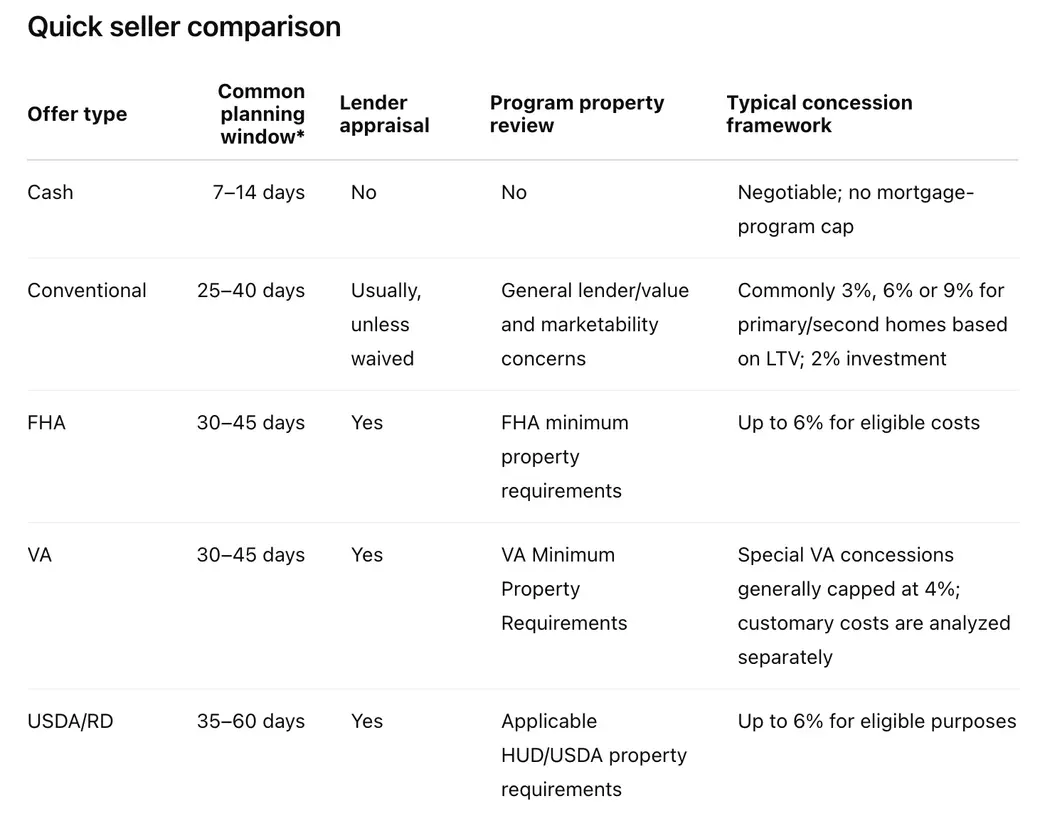
Typical speed: A straightforward cash transaction may close in approximately 7–14 days, although the buyer may request more time for inspections, title work or other due diligence.
Inspection and appraisal: A cash buyer may still include a private inspection contingency and may order an appraisal for personal reassurance. Neither is automatically eliminated just because the offer is cash.
Seller concessions: Cash buyers can negotiate credits or price reductions, but there is no mortgage-program concession limit. Any credit still needs to be clearly documented and handled properly at closing.
Pros for the seller:
- Usually the fastest option
- No financing or lender-appraisal contingency unless the contract creates one
- Fewer lender-related delays and conditions
- Property condition may be less restricted, depending on the buyer’s terms
Possible cons:
- Cash buyers sometimes expect a discount in exchange for speed and certainty
- “Cash” should still be supported by acceptable proof of funds
- A cash offer can still contain inspection, title, sale-of-property or other contingencies
- Cash does not guarantee that the buyer cannot default
My seller takeaway: Cash can be very attractive, but we still verify the funds and read every contingency. The word “cash” by itself does not make an offer perfect.
Conventional financing
A conventional mortgage is not insured by FHA, VA or USDA. Its guidelines commonly follow Fannie Mae or Freddie Mac standards, along with the lender’s own requirements.
Typical speed: Approximately 25–40 days is common, although a fully underwritten buyer and an efficient lender may close sooner. I've seen them close as fast as 10 days!
Inspection and appraisal: The buyer may elect a private home inspection. The lender will usually require an appraisal unless an eligible appraisal waiver is granted. A conventional appraisal focuses primarily on market value and marketability, but serious safety, structural or condition issues may still be called out or made subject to repair.
Seller concessions: For many Fannie Mae conventional loans on a primary residence or second home, the maximum financing concession is generally:
- 3% when the loan-to-value ratio is greater than 90%
- 6% when it is 75.01%–90%
- 9% when it is 75% or less
- 2% for an investment property
The buyer cannot simply receive unused concession money as cash. The allowable amount also depends on actual eligible closing costs, the lender and the specific loan program.
Pros for the seller:
- Often viewed as flexible and competitive
- Property-condition requirements are generally less strict than government-backed financing
- May allow a quicker closing with a strong lender and well-qualified buyer
- A larger down payment or appraisal-gap provision may reduce appraisal risk
Possible cons:
- The transaction is still subject to financing and underwriting
- A low appraisal can create renegotiation or termination rights, depending on the contract
- The buyer’s approval can change if employment, credit, debt or assets change before closing
- A low-down-payment conventional offer is not necessarily stronger than a well-qualified government-loan offer
My seller takeaway: Conventional financing is often a comfortable middle ground, but I still want to know whether the buyer is merely prequalified, fully preapproved or already through underwriting—and whether the lender is known for closing on time.
FHA financing
An FHA loan is made by an approved lender and insured by the Federal Housing Administration. It can help buyers who have a smaller down payment or need more flexible qualifying guidelines.
Typical speed: Approximately 30–45 days is common. It can close faster when the buyer and lender are prepared and the property has no repair issues.
Inspection and appraisal: A buyer may still obtain a private inspection. In addition, the FHA appraisal evaluates value and whether the home meets FHA minimum property requirements. The appraiser may require correction of conditions involving health, safety or the property’s continued marketability before closing. Examples can include peeling paint in a pre-1978 home, exposed wiring, active roof leaks, missing safety handrails or inadequate utilities—but repairs depend on the actual condition and current FHA guidance.
Seller concessions: FHA generally permits interested parties to contribute up to 6% of the sales price toward eligible closing costs, prepaid expenses, discount points and other permitted items. The buyer cannot receive excess funds as cash, and the credit must be supported by allowable costs.
Pros for the seller:
- Expands the pool of qualified buyers
- A buyer may be very solid even with a smaller down payment
- Up to 6% in allowable seller contributions can help structure a transaction without automatically reducing the seller’s price
- FHA financing is widely used and familiar to experienced lenders and agents
Possible cons:
- The appraisal includes FHA property standards, so repairs may be required before closing. If weather doesn't allow repairs, an escrow of 1.5x the cost is typically held (paid by buyer or seller).
- A reinspection may be needed after repairs
- A low appraisal can affect the transaction, subject to the contract and FHA amendatory language
- Timing can extend if underwriting or repairs are not handled promptly
My seller takeaway: Do not reject an FHA offer simply because it is FHA. I look at the home’s condition, the buyer’s pre approval, the lender, the requested concessions and the complete net proceeds.
VA financing
A VA loan is a benefit available to eligible veterans, active-duty service members and certain surviving spouses. The loan is made by a private lender and backed in part by the U.S. Department of Veterans Affairs.
Typical speed: Approximately 30–45 days is common, and experienced VA lenders can sometimes close sooner.
Inspection and appraisal: The buyer may obtain a private inspection. The VA also requires a VA appraisal to establish reasonable value and review the home against VA Minimum Property Requirements. Safety, sanitation and structural concerns may require correction. The VA appraisal is not a full home inspection.
In Michigan, VA does not impose a statewide wood-destroying-insect inspection requirement merely because the loan is VA; one may still be required if the appraiser or lender identifies a concern or another applicable requirement calls for it.
Seller concessions: VA’s 4% cap applies to defined seller concessions, such as certain buyer debts or funding-fee payments. Many customary seller-paid closing costs are treated separately and are not automatically part of that 4% calculation. The lender and closing professionals should confirm the exact allowable structure.
Pros for the seller:
- VA buyers have earned a valuable home-loan benefit and can be exceptionally strong buyers
- VA generally does not require a down payment, although a buyer may choose to make one
- No monthly private mortgage insurance is required by VA
- Experienced VA lenders can make the process smooth and predictable
Possible cons:
- VA Minimum Property Requirements may result in repairs and a reinspection
- The VA Escape Clause protects the buyer from being required to complete the purchase above the VA-established value under the clause’s terms
- An inexperienced lender or agent can create unnecessary confusion about VA rules
- Zero down does not provide an automatic appraisal gap
My seller takeaway: A VA offer should never be treated as inferior simply because it is VA or because the buyer is using zero-down financing. I focus on the buyer’s approval, lender performance, property condition and the offer’s actual protections.
USDA Rural Development financing
USDA Rural Development financing—often simply called an RD or USDA loan—is designed for eligible buyers purchasing a primary residence in an eligible area. Eligibility depends on both the property location and household/program requirements. Despite the name, eligible areas may include communities that do not feel especially rural.
Typical speed: Approximately 35–60 days is a reasonable planning range. Timing depends heavily on the lender, underwriting volume, appraisal and whether USDA review is required at that stage of the process.
Inspection and appraisal: The buyer may obtain a private inspection. USDA requires an appraisal, and an existing home must meet applicable HUD minimum property requirements. Repairs needed for health, safety, marketability or program compliance may have to be completed or handled through an approved repair-escrow process when allowed.
Seller concessions: USDA generally limits seller or other interested-party contributions to 6% of the sales price for eligible purposes. The buyer cannot receive unused money back as cash, and the final credit is limited by program and actual-cost requirements.
Pros for the seller:
- Can provide 100% financing for an eligible buyer and property
- Opens the home to buyers who may have strong income and credit but limited cash for a down payment
- Allows up to 6% in eligible seller contributions
- Can be an excellent option when the home is in good condition and located in an eligible area
Possible cons:
- Often needs a longer closing window
- Both the buyer and property must meet program eligibility rules
- The appraisal/property review may require repairs
- Additional review steps or an inexperienced lender can delay closing
My seller takeaway: USDA financing can be a very good offer, but we should confirm property eligibility, allow a realistic timeline and evaluate the lender’s USDA experience.
These are planning estimates, not guarantees. Market conditions, lender workload, appraisal availability, title issues, buyer documentation and repairs can change the timeline.
Which offer is best for the seller?
There is no universal winner.
The strongest offer is the one that gives you the best combination of:
- Net proceeds after concessions and other seller-paid costs
- Buyer qualification and available funds
- Financing and appraisal protections
- Inspection terms
- Earnest money deposit
- Closing timeline and occupancy terms
- Appraisal-gap coverage, if any
- Property-condition risk
- Lender quality, communication and track record
- Overall likelihood of reaching the closing table
A $300,000 offer asking for $9,000 in concessions may net less than a $296,000 offer with no concession. A cash offer may close faster but be priced lower. A VA, FHA or USDA buyer with a strong approval and excellent lender may be a safer transaction than a conventional buyer whose financing has not been thoroughly reviewed.
That is why I prepare a side-by-side offer comparison and help my sellers evaluate the whole offer—not just the headline price or the loan label.
Let’s choose the offer that works best for you
Selling a home involves more than selecting the biggest number on the page. I will help you understand the financing, identify the risks, compare estimated net proceeds and negotiate terms that support your priorities.
Thinking about selling your Michigan home? Let’s talk about how to prepare your property, attract qualified buyers and evaluate every offer with confidence.

Let's chat soon!
Maria Reyes, REALTOR ®️,
Power Award Agent, Team & MI Area Leader
Modern Living Collective brokered by Epique Realty
Cell 248-943-2250
I ❤️ referralsa
*This article is general educational information and is not legal, tax or lending advice. Loan guidelines, lender overlays and program requirements can change. Buyers and sellers should confirm transaction-specific requirements with their lender, title professional and other appropriate advisors.*
## Sources
- [Fannie Mae Selling Guide: Interested Party Contributions](https://selling-guide.fanniemae.com/sel/b3-4.1-02/interested-party-contributions-ipcs)
- [HUD FHA: Seller and Interested-Party Contributions](https://answers.hud.gov/FHA/s/article/What-costs-can-a-seller-or-other-interested-party-pay-on-behalf-of-the-Borrower)
- [U.S. Department of Veterans Affairs: VA Home Loans](https://www.benefits.va.gov/homeloans/)
- [VA: Escape Clause Requirements](https://www.benefits.va.gov/homeloans/escape-clause.asp)
- [VA: State Wood-Destroying-Insect Requirements](https://www.benefits.va.gov/HOMELOANS/appraiser_cv_local_req.asp)
- [USDA Rural Development: Guaranteed Loan Program—Eligible Loan Purposes and Seller Contributions](https://www.rd.usda.gov/media/file/download/usda-rd-chapter-6-draft-11072024.pdf)
- [USDA Rural Development: Property and Appraisal Requirements](https://www.rd.usda.gov/media/file/download/usda-rd-chapter-12-draft-11072024.pdf)

GET MORE INFORMATION